





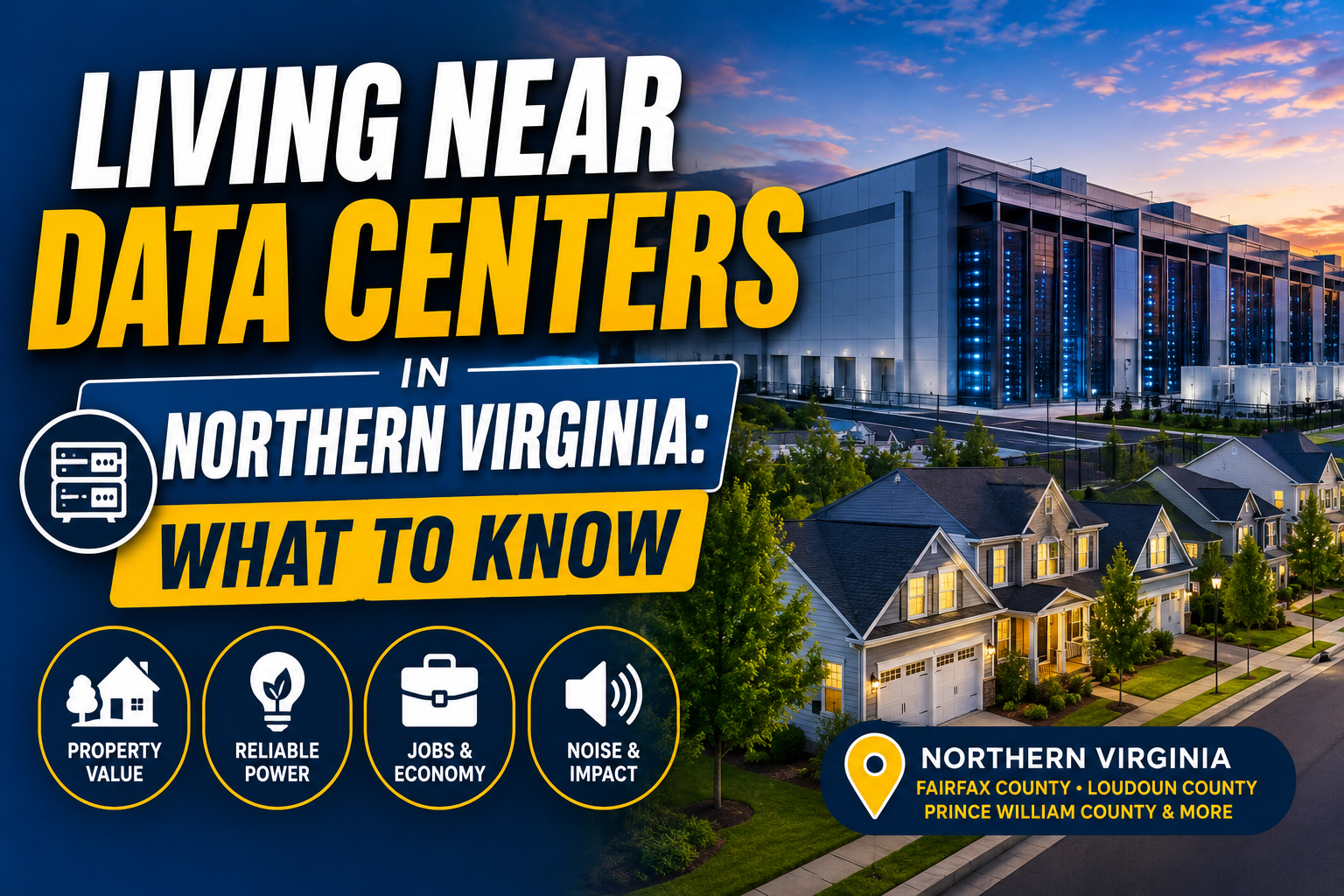

Northern Virginia is home to roughly 35% of the world's data centers, and headlines about humming noise, diesel generators, and property value fears have made plenty of buyers nervous about anything labeled Data Center Alley. But local Reddit threads full of actual residents, along with county noise complaint data and recent assessment reports, tell a more mixed story than the scariest headlines suggest. This guide looks at what living near a data center in Northern Virginia is really like, where the real complaints are coming from, where the impact tends to be minimal, and what buyers should actually check before ruling a home out. If you are weighing a home near a data center corridor and want a clear read on the specific property, start with a free home valuation, or connect with Team DDA to talk through the details before you decide.
Quick Facts About Data Centers and Nearby Homes in Northern Virginia
- Northern Virginia hosts roughly 35% of the world's data center capacity, concentrated heavily in Loudoun and Prince William counties, with growing development in Fairfax County as well
- Loudoun County has more than 200 operating data centers and roughly 100 more in the pipeline, with the industry funding close to 45% of the county's budget through tax revenue
- Loudoun County's noise ordinance currently caps industrial sound at 55 decibels measured at residential property lines, though officials are actively considering lowering that threshold to address low frequency hums
- A 2024 Joint Legislative Audit and Review Commission report found noise was negatively affecting some residents near facilities, prompting counties to begin requiring noise studies and sound buffering as part of the approval process
- Recommended buffer distances in newer local ordinances commonly range from 200 to 500 feet between a data center and the nearest residential property line
- 2025 assessment data from Loudoun County showed continued growth in both residential home values and the county's data center tax base, suggesting regional demand has largely offset localized concerns at the county wide level
- Complaints tend to cluster tightly around a small number of specific facilities rather than being spread evenly across the region, which is a key reason online experiences vary so widely
These numbers point to an important pattern. Impact is not uniform. It clusters heavily around specific facilities and specific distances, which is exactly what shows up when you read through actual resident accounts rather than headline summaries alone.
What Residents Actually Say in Local Forums
Local community forums, including several r/nova threads specifically dedicated to the topic, paint a more nuanced picture than the most alarming news coverage. A recurring theme across these discussions is that impact depends heavily on exact proximity, prevailing wind direction, whether the facility backs directly up to a neighborhood or sits behind a commercial buffer, and whether backup generators have had to run recently.
Some residents living within a mile or two of a data center report barely noticing it in daily life, particularly in neighborhoods separated from a facility by tree buffers, berms, or several hundred feet of distance. Others living directly adjacent to a facility, especially older ones built before current buffer and noise requirements existed, report a persistent low hum that becomes most noticeable at night when ambient neighborhood noise drops. The difference between these two experiences often comes down to a few hundred feet and the specific design of the facility involved, not simply whether a data center exists somewhere in the general area.
Where the Real Complaints Are Concentrated
It's worth being direct about where documented problems have actually occurred. Loudoun County's Board of Supervisors has fielded a genuine wave of complaints tied to specific facilities, including a Vantage Data Centers campus in Sterling where neighbors reported a constant hum along with diesel fumes after a power outage forced a switch to backup generators. County officials confirmed receiving a dozen formal noise complaints tied to that campus in a single year, and supervisors have publicly acknowledged the issue is real enough to warrant updating the county's noise ordinance to better capture the low frequency, tonal hum that residents say standard decibel measurements don't fully account for.
Air quality has also come up in county discussions and state level reporting, particularly around the use of diesel backup generators during grid stress events. A 2026 academic review of emissions data from data centers with Virginia environmental permits found that while most facilities used only a small share of their permitted emissions in an average year, a minority of facilities used a meaningfully higher share, meaning the risk is not evenly distributed across every facility in the region.
None of this means every home near a data center experiences these issues. It means specific facilities, particularly older ones close to residential property lines and those that have needed to lean on backup generators, are where the documented complaints concentrate.
Why Property Values Haven't Collapsed Regionally
Despite the noise and air quality headlines, county level data tells a more resilient story for home values overall. Loudoun County's 2025 assessment data showed both residential property values and the county's data center tax base continuing to rise together, which reflects the strength of regional housing demand outweighing localized concerns at the county wide level. Some analysts have pointed to this as evidence that the broader real estate market has, so far, priced in economic benefits like strong local tax revenue, funding for schools, and continued job growth alongside whatever localized noise or visual impact exists.
That said, county wide data can mask what happens to individual properties sitting immediately next to a specific facility. A home directly backing up to an older, un-buffered data center campus is a different situation than a home a mile away in a neighborhood with no direct sightline or noise exposure, even though both technically sit in the same broader market. Buyers should treat county wide trends as context, not as a guarantee for any specific address.
What Actually Determines Whether You'll Notice a Data Center
Based on both resident accounts and the factors regulators have focused on in recent zoning changes, a handful of variables determine most of the real world impact:
- Distance to property line, with newer ordinances commonly requiring 200 to 500 feet of buffer between a facility and residential property
- Facility age, since older campuses built before current buffer and sound requirements tend to generate more complaints than newer ones designed with mitigation in mind
- Landscaping and physical buffers, including berms, tree lines, and sound walls, which meaningfully reduce how far noise travels
- Backup generator usage, since noise and fume complaints spike sharply during grid stress events or facility outages rather than during normal day to day operation
- Topography and wind direction, which residents in forum discussions frequently mention as a factor in whether hum or fumes are noticeable on a given day
Practical Tips for Buyers Considering a Home Near a Data Center
If you are considering a home near an existing or planned data center, a few simple steps can tell you far more than a general news headline ever will.
- Visit the property at night, when ambient neighborhood noise drops and any mechanical hum becomes easiest to detect
- Ask the listing agent or seller directly whether the home has ever generated a noise or odor complaint, and check the county's public complaint records if available
- Look up whether the specific facility involved is subject to newer buffer and noise requirements or was built before current ordinances took effect
- Check for physical buffers, including tree lines, berms, or distance, between the property and the nearest facility structure
- Ask about planned expansions nearby, since a currently quiet lot next to an empty parcel zoned for future data center use is a different risk profile than a lot next to a fully built out, mature campus
Frequently Asked Questions About Living Near Data Centers in Northern Virginia
Do all homes near data centers in Northern Virginia have noise problems? No. Complaints concentrate heavily around specific facilities, particularly older campuses close to residential property lines, while many residents living farther away or behind buffers report little to no noticeable impact.
Has living near a data center hurt home values in Northern Virginia? At the county level, no. Loudoun County's 2025 assessment data showed home values continuing to rise alongside the county's data center tax base. Individual properties directly adjacent to an older, un-buffered facility may be a different story than the broader county trend.
How close is too close to a data center? There is no single universal answer, but newer local ordinances commonly require buffers of 200 to 500 feet between a facility and the nearest residential property line, and impact tends to drop off meaningfully beyond that range, especially with landscaping buffers in place.
Are data center noise complaints being addressed? Yes. Loudoun County officials have acknowledged the issue publicly and are actively reviewing the county's noise ordinance, including potentially lowering the current 55 decibel threshold and better accounting for low frequency, tonal hum.
Is diesel generator noise and pollution a regular issue, or only during outages? Complaints spike sharply during grid stress events, power outages, or testing periods when facilities switch to backup diesel generators, rather than being a constant daily issue under normal operating conditions.
Should I avoid buying near a data center entirely? Not necessarily. Given how much impact depends on exact distance, buffers, and facility age, the smarter approach is evaluating the specific property and facility involved rather than avoiding an entire region based on general headlines.
The Bottom Line on Living Near Data Centers in Northern Virginia
The honest answer sits between the scariest headlines and the most dismissive reassurances. Real, documented noise and air quality complaints exist, and they are concentrated around specific facilities, particularly older ones close to homes. At the same time, regional home values have continued climbing, many residents living even within a mile or two of a facility report minimal day to day impact, and newer buffer and noise requirements are specifically designed to reduce these issues going forward. The right move for any buyer is evaluating the specific property, its distance, and the facility involved rather than treating every home near Data Center Alley the same way. If you are weighing a specific property near a data center corridor, get a free home valuation or reach out to Team DDA to talk through what it actually means for that address.

Debbie Dogrul Associates, known as Team DDA, is the number one eXp Realty team in Virginia and one of Northern Virginia's most trusted real estate teams. With more than 35 full-time Realtors, over 540 homes sold annually, nearly $400 million in 2025 sales volume, and 2,030+ five-star reviews, Team DDA brings deep local expertise to Fairfax County, Arlington, Alexandria, Loudoun County, Prince William County, and communities across Northern Virginia including Burke, Vienna, Reston, McLean, Tysons, Herndon, and Springfield. From pricing strategy and professional marketing for sellers to offer negotiation and closing support for buyers, our full-service approach is built to help clients move with confidence in a competitive market. Beyond real estate, Team DDA gives back through the DDA Love Foundation, contributing more than $100,000 in 2025 to local families, students, and nonprofits across the region.
Ready to make your next move? Get a free home valuation or connect with Team DDA to work with one of Northern Virginia's top real estate teams.
Check out this article next